·
6 min read
Agent-to-Extension (A2E): Making Voice AI a Native Part of Telecoms
James Bolger
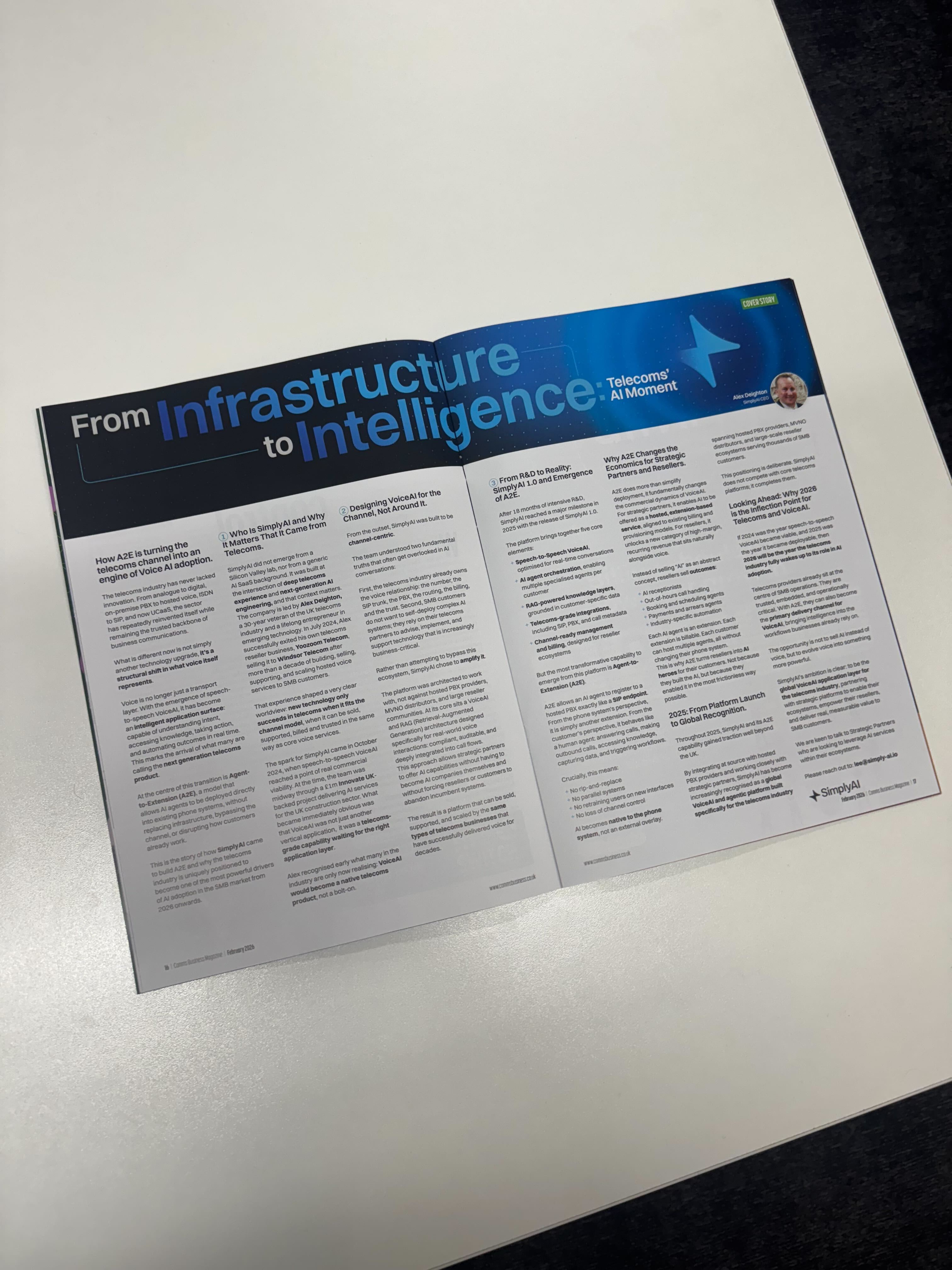
Agent-to-Extension (A2E): Bringing Voice AI Inside the Telecoms Stack
Telecoms has always been central to how businesses communicate. Phone systems sit at the entry point for customer enquiries, bookings, support requests, and sales conversations. Despite advances in digital channels, voice remains the most direct and trusted way for customers to engage with a business.
At the same time, expectations around speed, availability, and responsiveness have changed. Customers no longer accept missed calls, long queues, or voicemail outside working hours. Businesses are under increasing pressure to respond instantly, regardless of time of day or call volume.
Agent-to-Extension (A2E) has been designed to address this shift by allowing Voice AI to operate directly within existing telecoms infrastructure.
What Is Agent-to-Extension (A2E)?
Agent-to-Extension allows an AI agent to register to a hosted PBX in exactly the same way as a SIP endpoint.
From the PBX’s perspective, the AI is simply another extension within the system. It can be assigned a number, placed in hunt groups, follow routing rules, and participate in call flows alongside human users.
From the caller’s perspective, the experience is a conversational digital employee that understands intent, responds naturally, and completes actions in real time.
There is no overlay platform, no external call routing, and no requirement to replace the customer’s existing phone system.
How A2E Works in Real Environments
Because the AI registers natively, it integrates into live environments without architectural changes.
This enables AI agents to:
Answer inbound calls during and outside business hours
Act as a receptionist or front-of-house call handler
Capture information and qualify callers before escalation
Manage bookings, cancellations, and appointment changes
Handle overflow during peak call volumes
Route calls intelligently based on intent rather than key presses
All of this happens within the customer’s existing PBX and numbering plan.
Why A2E Matters to the Telecoms Channel
Agent-to-Extension has been built specifically with resellers and service providers in mind. The design choices behind A2E reflect how telecoms services are sold, provisioned, and supported today.
Integration Without Disruption
Customers are often hesitant to replace their phone systems. Migrations introduce cost, downtime, and risk, which can slow or block adoption of new services.
A2E removes this barrier by working inside the existing hosted PBX. The AI extension behaves like any other endpoint, allowing deployments to move quickly without large technical projects.
For resellers, this reduces pre-sales complexity and shortens decision cycles.
Clear, Outcome-Driven Sales Conversations
A2E allows Voice AI to be positioned as a set of practical services rather than an abstract technology.
Sales conversations remain focused on outcomes customers already recognise:
Calls answered outside normal hours
Reduced pressure on reception and support teams
Consistent call handling during busy periods
Improved customer experience without increasing headcount
These outcomes align naturally with existing voice services, making it easier for customers to understand the value and for resellers to position the offering.
Commercial Models That Already Work
Agent-to-Extension fits into established billing and provisioning workflows used by telecoms providers.
Voice AI services can be packaged as recurring extensions or value-added services rather than one-off software projects. This creates predictable revenue and supports strong margins while avoiding complex licensing structures.
Because the AI lives inside the PBX, it can be managed alongside existing voice services rather than as a separate product line.
Lower Operational Overhead
Support and operations teams do not need to manage multiple disconnected platforms.
Provisioning, call routing, number assignment, and ongoing support follow familiar processes. This keeps operational overhead low and reduces the learning curve for internal teams.
The result is a service that can scale without increasing complexity.
Channel Ownership and Trust
A2E has been designed to reinforce the role of the reseller, not bypass it.
The reseller retains ownership of the customer relationship, the phone numbers, and the ongoing service delivery. Customers continue to see their telecoms provider as the primary point of contact, even as advanced Voice AI capabilities are introduced.
This protects long-term relationships and preserves trust.
Built by Telecoms Specialists
SimplyAI has been built by teams with deep experience in telecoms and the channel. The focus has been on delivering Voice AI in a way that aligns with how telecoms businesses operate in the real world.
Agent-to-Extension exists to close the gap between traditional telephony and modern Voice AI, without forcing the channel to change how it works.
Voice AI as a Native Telecoms Capability
Voice AI adoption is accelerating, and customer expectations continue to rise. As this technology matures, it will increasingly be expected as part of standard business telephony rather than as an external add-on.
Agent-to-Extension ensures Voice AI remains inside the telecoms stack, delivered by the channel, and aligned with existing systems and commercial models.
For resellers, this creates an opportunity to expand service offerings while maintaining control, margin, and customer trust.